
At purchase
The tax-inclusive price of the home and its ancillary units, reduced notary fees (around 2 to 3 % of the price for new-build property), loan arrangement and guarantee fees, and furniture if you let furnished.

Gross yield, net yield, cash flow before tax: JL HOME selects and compares new-build homes suited to letting, explains the possible schemes to you and supports you through to the handover of keys.
Who it's for
Adjust the price, rent, charges or credit: the diagram recalculates the three figures that matter, before tax. The starting values form an adjustable example, not a property from the catalogue.
Once the charges are paid, the rents cover 52 % of the loan. It remains 585 € to be completed each month: this is your saving effort, before tax.
Price including all taxes
Excluding service charges
Per year: co-ownership fees, property tax, non-resident owner insurance
Months without a tenant, each year
Share of price, soit 22 000 €
Fixed rate, excluding insurance
In years
Reduced new-build notary fees, as a % of price, soit 5 500 €
As a % of rent collected, 0 if you manage it yourself
Per year, as a % of the borrowed capital
Before tax. Tax treatment depends on the scheme chosen (LMNP, Jeanbrun, LLI…) and your situation: it may ease or increase the monthly outlay. Your adviser will review it with you based on actual homes.
The tax-inclusive price of the home and its ancillary units, reduced notary fees (around 2 to 3 % of the price for new-build property), loan arrangement and guarantee fees, and furniture if you let furnished.
Le paiement suit l'avancement du chantier, selon un échéancier encadré par la loi. Des intérêts intercalaires courent sur les sommes déjà versées, et aucun loyer n'arrive avant la remise des clés.
Non-recoverable co-ownership charges, property tax, non-occupying owner’s insurance, management if you entrust it, accounting under the régime réel, and upkeep.
Capital gains follow the rules of each regime. Under LMNP (real regime), since 2025, depreciation deducted generally reduces the purchase price taken into account. Leaving a scheme early may cost the benefit obtained.
A scheme changes the tax treatment and the constraints, not the quality of the home: location and the rent realistically achievable come before the tax advantage. Here are the main frameworks for a new home, with their key conditions.
You let furnished. Under the actual-expenses tax regime, expenses and depreciation of the home (excluding land) reduce taxable income; under micro-BIC, an allowance of 50 % applies. The status remains non-professional as long as annual receipts stay below 23,000 € or below the household’s other earned income.
Find out more : LMNPA new-build apartment in a multi-unit building, let unfurnished as a main residence for at least 9 years, with caps on rent and tenants’ incomes. Each year, 3.5 to 5.5 % of 80 % of the price is deducted from property income, up to 8,000 to 12,000 € per year depending on the rent level.
Find out more : Jeanbrun (private landlord status)A 10% VAT rate instead of 20% on purchase, reserved for legal entities (a SCI, for example). The home, located mainly in zone A bis, A or B1, is rented as a main residence at capped rents and incomes for 20 years.
Find out more : LLIYou buy bare ownership at a price set for the development; a landlord holds the usufruct and receives the rent for a defined period. You receive no rent during that period and regain full ownership at the end specified in the contract.
Find out more : Bare ownershipDepending on your project and situation, certain schemes may or may not apply. Your JL HOME adviser will go through this with you.
A few residences identified for letting, each with a reference home. Eligibility for a scheme is checked home by home with your adviser.
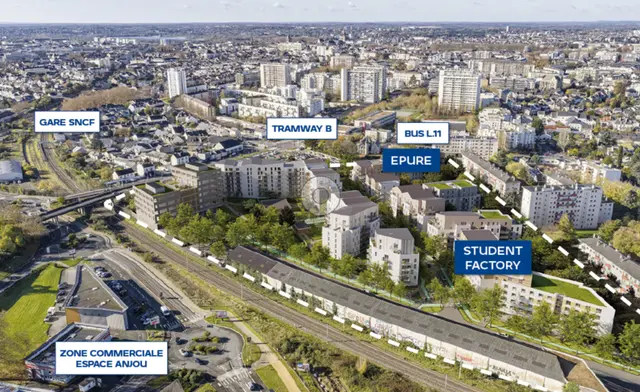 Residence image · non-contractual
Managed residence investment: the home is let to an operator. Options for personal occupation depend on the lease, to be checked before purchase.
Expected delivery Q2 2029
 Residence image · non-contractual
Managed residence investment: the home is let to an operator. Options for personal occupation depend on the lease, to be checked before purchase.
Expected delivery Q2 2029
 Residence image · non-contractual
PTZ possibly available for this property: main residence, subject to income conditions, first-time buyer status and bank approval.
Expected delivery Q4 2026
Gross yield (annual rent divided by price) is used to compare two homes quickly. Net yield deducts vacancy and charges, and adds acquisition costs to the price: it is closer to reality. For your budget, the decisive figure remains monthly cash flow, i.e. what is left or what must be topped up once the loan is repaid, before tax.
New build offers a home that meets current standards, reduced notary fees, and the 'parfait achèvement' guarantee as well as the biennial and decennial guarantees. In return, the price per square metre is often higher than for existing property, and rents only begin on delivery.
It all depends on the type of letting targeted (furnished or unfurnished), your tax position, how long you can commit for and the property itself. Your adviser compares the options on real properties; for your personal tax situation, the advice of a chartered accountant or tax adviser remains useful.
Not always, but banks often ask you to cover at least the acquisition costs. A larger deposit reduces the monthly repayment and therefore the monthly effort: try it in the diagram on this page. JL HOME supports the purchase of the home and is not a credit intermediary: the loan is negotiated with the bank of your choice.
JL HOME is a new-build estate agency holding the carte T. Its fees are paid by the developer, as stated in the regulatory notice at the bottom of the page. Its role: to select and compare homes, explain their figures to you and support you right up to the handover of keys.
A JL HOME adviser selects with you homes suited to your project, redoes this calculation with their actual figures and explains the scheme that may be available to you.
Review your position with an adviser